DISASTER FICTION
A Test of Our Humanity

Recently, the TV show Lost (2004)1 has become available on Netflix. It has made a great improvement to the overall quality of the notorious streaming service. But that aside; I have been watching it avidly for over a week now and it has caused me to ask some uncomfortable questions about myself, and human nature in general.
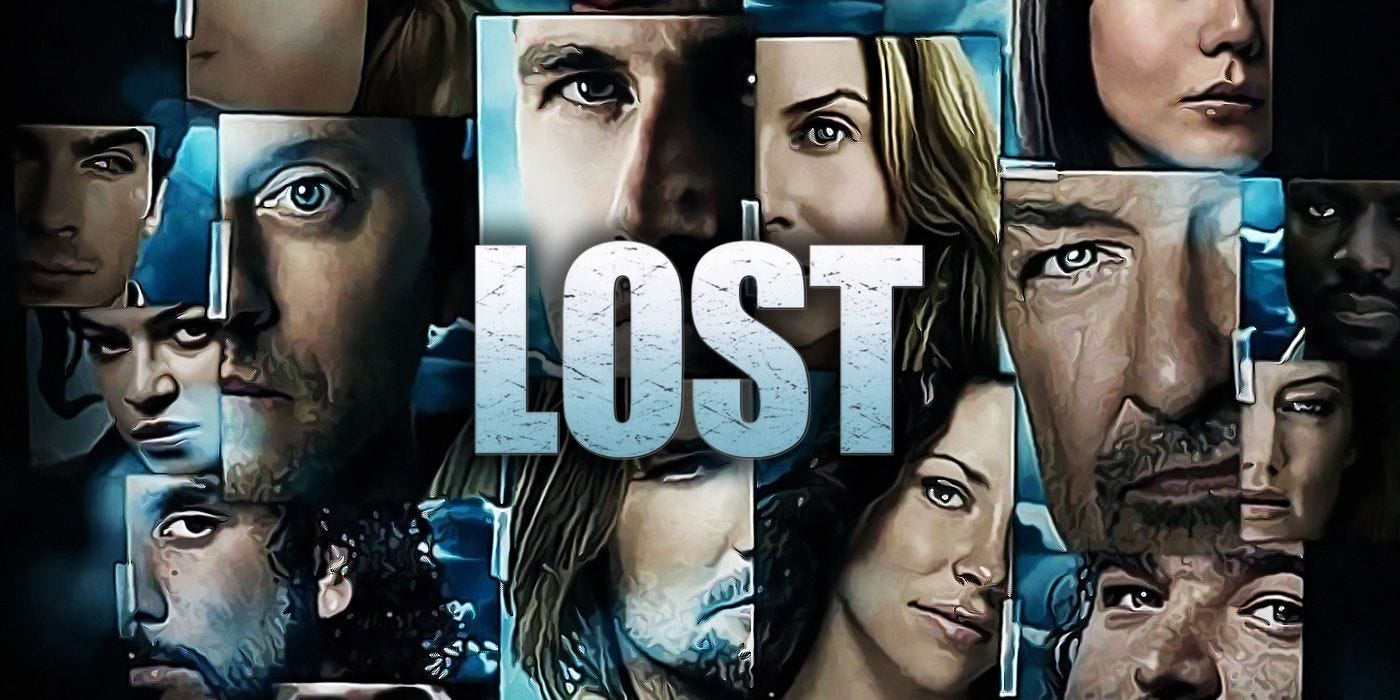
For those unfamiliar with the twenty-year-old hit TV production, filmed on glorious, 35mm film stock, it is the story of a group of over forty survivors stranded on a deserted, tropical island after a plane crash.
The reason for my opening gambit is that, when I come across a story like Lost, I can’t help but ask questions like: what would I do in this situation? How moral would I be? Could I survive for long? You get the idea, and I’m sure many of you are the same.
When it comes to online entertainment, I’m also a fan of ‘reactor’ channels. For those unfamiliar with this subculture, content creators, usually on YouTube, react to edited-down versions (for copyright reasons) of classic movies for the first time, offering (sometimes) an authentic first take. One of my favourite reactor channels is Popcorn in Bed, hosted by the particularly photogenic Canadian lady, Cassie.
As of the writing of this piece, her most recent upload is THE POSEIDON ADVENTURE (1972) | FIRST TIME WATCHING | MOVIE REACTION2 , starring Gene Hackman. Together with Lost, it is the inspiration for writing this post. Both stories are about a seemingly random group of strangers, travelling over the open ocean (‘The Poseidon’ is an old cruise ship), that suffer a catastrophic accident, leaving the Lost passengers marooned on a deserted island, and the Poseidon passengers and crew crawling on the ceiling, after a huge, freak wave capsized their ship; the threat of it being swallowed by the Mediterranean a constant terror ravaging the psyches of the survivors, not sure of what to do from one scene to the next.
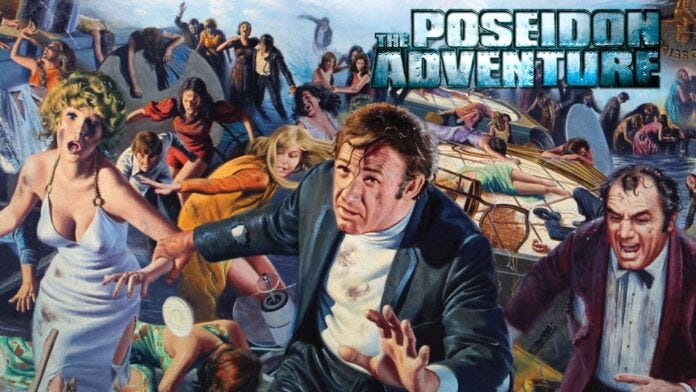
All the survivors are quite understandably in a state of shock, fear, confusion et cetera, but their reactions to these intense emotions and their subsequent behaviour is what makes the drama truly gripping. With both groups, the tension initially occurs between those that wish to be rescued and some who can face the prospect that they may well be on their own for the long-term, and that their survival is solely in their own hands.
Gene Hackman, playing the unconventionally rebellious and prideful priest, Reverend Scott (as if he was still playing Popeye from The French Connection, having swapped his gun for a dog collar), takes it upon himself to argue with the crew about the need to try and escape. He manages to drag some of the other survivors with him by climbing a Christmas tree (yes, it’s a disaster movie set during the holiday season *cringe*), just before the mob below, castigating him for being so reckless, is consumed by a tide of seawater that bursts into the ballroom.
Being an epic, episodic television show, Lost gets off to a more ambiguous start. It is dramatic for sure, Dr Jack (Matthew Fox) having to save a pregnant woman from an exploding airliner. But its momentum slows into angst-ridden confusion, as their understanding of reality is gradually subverted by unseen forces emanating from the island they reluctantly call home.
This is where a distinct point of demarcation emerges between the two stories. Both Lost and The Poseidon Adventure are tense, gritty, tragic, and downright disturbing, but, whereas one group ascends (with great difficulty) to virtue, the other slides dangerously toward an abyss of nihilism and zero-sum thinking. Of course, such stories are nothing new. William Golding’s Lord of the Files comes to mind. But I believe that was a cautionary tale, you could say almost biblical in its narrative, exploring the worst adolescent behaviour possible.
Lost is much more of a psychological malaise, as most of the characters are well into adulthood. From the get-go, the characters’ sanity is assaulted by strange animals not native to the tropics, a giant, invisible monster, unexplained ethereal apparitions, and hallucinations of dead people from their chequered pasts. The mental stability of the Poseidon survivors, for the most part, though desperate and full of existential terror, is more stable, decisive, and cooperative.
Some of the characters in The Poseidon Adventure are far from perfect, too. Linda Rogo (Stella Stevens) is a former prostitute, and her husband, Mr Rogo (Ernest Borgnine), is a gruff detective with a short fuse, who, it is implied, wasn’t shy about bending the law to get Linda’s attention. He could also have been a former customer of hers as well.
Despite all of this and more, the characters in The Poseidon Adventure show a great deal more restraint in moments of interpersonal conflict. At one point, Scott and Rogo lay their hands on each other and almost come to blows. But their outburst of barbarity is immediately and decisively interrupted by the other survivors, leading to a beneficial outcome. No such moral arbitration is attempted much in Lost, and if it is, it is weak, unsure of itself, and usually fails. The Poseidon survivors are also able to grieve the terrible losses they suffer along the way, many succumbing to death before the lucky few make it to safety. Even the hot-headed Rogo, blaming Scott for his wife’s fatal fall, took a moment to weep without making the situation worse. When something tragic happens in Lost, the characters usually just lash out or go semi-catatonic, leading to even more dysfunctional machinations later on.
Not all the characters in Lost are beyond the pale. The pregnant lady saved in the first episode, Claire (Emilie de Raven), has a touching and moving character arc (I’ll admit it, I cried), as she struggles with giving birth on a deserted island, and subsequently caring for a baby as a single parent surrounded by people she can’t entirely trust, not to mention the paranormal forces (mentioned above) that take an unhealthy interest in mother and child alike.
Even though The Poseidon Adventure was made in the immediate aftermath of the Sixties Cultural Revolution, the virtues the characters exhibit, when tested, belong to a previous era. Most of the leading cast were born before World War Two, coming of age in a slower, gentler, more civilised and cohesive society. The characters in Lost, even those of more advanced years, were not so fortunate.
Comparing the two disaster stories reveals what’s happened to Hollywood morals in the last fifty years. I don’t think it’s much of a stretch to say, these two works show where the societies of the developed world were and now are. Interestingly, the leading man in The Poseidon Adventure is a priest. In Lost, though the character John Locke (Terry O’Quinn) has some vague spiritual notions about ‘the island’ he trots out every now and again, it isn’t until well into season two that anyone claiming to be a priest appears, in the character of Mr Eko (Adewale Akinnuoye-Agbaje). Even then, I can’t remember him once invoking the name of the Lord Jesus Christ, and his words and conduct, even when compared to the rough Reverend Scott, are quite unbecoming for a man of the cloth. Scott, on the other hand, introduces himself to the audience with fiery sermon and theological argument. How many audience members would bother to listen to that nowadays?
At the end of the film, Scott makes the ultimate sacrifice to save the few remaining survivors. No such heroism was exhibited by anyone in Lost, and I’m over fifty episodes in! They have vague notions of needing to save certain people from hostile natives, but sooner or later, ad hoc ethics derail any noble effort, as the characters lurch from one crisis to the next.
As concerns a modern audience, the title Lost is quite apt, because, as a collective, psychologically that’s exactly what so many of us are nowadays – lost! The story of the show is a microcosm for the Western, postmodern way of life, and it’s even more relevant twenty years after the show first aired.
It was also just happenstance that I heard a certain golden oldie a few days ago; Message in a Bottle by The Police. The lyrics seem to address the postmodern, existential anxiety of the Lost protagonists, as it does for so many trying to get by in our vaguely identified and rapidly changing twenty-first-century world. I think Sting was onto something when he sang: “Just a castaway, an island lost at sea, oh! Another lonely day, no one here but me, oh! More loneliness than any man could bare. Rescue me before I fall into despair, oh!… Woke up this morning, I don’t believe what I saw. Hundred billion bottles, washed up on the shore. Seems I’m not alone in being alone. Hundred billion castaways, looking for a home.”
I think you get the idea. Enjoy the music: